
After taking the medicine for about a month, he felt his body become lighter. He still mixes red ginseng with his coffee every morning. On the 22nd, when we met at Dongwon Japan's headquarters in Shinjuku, Tokyo, Nagase said, "I'm very healthy.
I also recommend it to friends who are interested in the topic," she said, smiling. "They especially appreciate the boost of energy they get when I give them a bag of red ginseng before playing nine holes at the golf course."
Red ginseng, a representative Korean health food, is attracting attention in Japan as a new export growth engine.
This is because exports of ginseng products to Japan are expanding beyond Korean food to include high-value-added health functional foods. Last year's exports of ginseng products to Japan increased 1.9% to $34.06 million from the previous year ($33.41 million).
Although the scale is still small, it is considered to have great potential for growth in Japan, where the market for functional health foods is well developed. In particular, all red ginseng is processed and exported from domestic farms.
Therefore, expanding exports is also significant in that it will lead to increased income for farmers and revitalization of the local economy. Against this backdrop, Dongwon Japan, which has established itself in the Japanese market through seaweed exports, has recently expanded into the red ginseng export market.
While Cheong Kwan Jang first attracted Japanese consumers with its "Pomegranate Red Ginseng" which is a product made by mixing pomegranate, Dongwon has made a direct push with the original taste and efficacy of red ginseng.
Although ginseng is still perceived as being "bitter and expensive," the company believes that once consumers experience its effects, they tend to become repeat customers.
In order to overcome the strict hurdles of Japan's functional health food certification, we are supporting the Korea Agro-Fisheries Trade Corporation (aT).
aT has conducted clinical trials in collaboration with Kyushu University in Japan to verify the various benefits of red ginseng. It is promoting the "memory improvement" function, which is in high demand in Japan.
Ha Ki-seok, CEO of Dongwon Japan, said, "Our challenge is not just to focus on functionality, but to expand the market through marketing that matches the sentiments of Japanese consumers."
"There is ample potential for growth," he said. Driven by the Korean Wave, exports of fresh agricultural products from Korea are also increasing. This trend is also evident at "Korean Plaza," a Tokyo store specializing in Korean food.
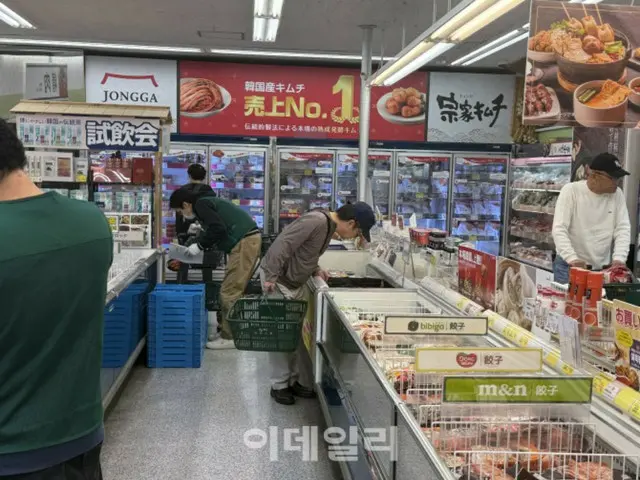
Located in Shin-Okubo, an area lined with Korean restaurants, the store was bustling with locals shopping while familiar K-POP music played.
Matsumoto (42), who came shopping with her husband from Yokohama, had a cart full of glass noodles, tteokbokki, chili powder, salted fish, ramen, and other items.
She said, "I like spicy food and often cook Korean food," and "I always stop by here every time I come to Tokyo, which is once or twice a year. It's cheap and I can buy fresh ingredients that I can't get anywhere else."
In fact, the most popular section in the store is the kimchi and fresh food section. The back wall of the store is lined with "Soke Kimchi" and homemade kimchi, and the fresh food section is filled with ego kimchi.
Korean vegetables such as radish and radish leaves were lined up. Korean radish sales have also started ahead of the kimchi-making season.
Baek Gye-hoon, manager of Korea Plaza, said, "Ramen and snacks have been popular for a long time, but
"With the growing popularity of Korean food, we have seen a noticeable increase in customers coming to buy Korean agricultural products that are hard to find elsewhere," he said.
Even in Japan, which was considered a mature market, various Korean
Attempts are being made to export agricultural products from Japan, creating business opportunities. However, concerns about domestic supply due to recent abnormal weather are an issue that must be resolved. If domestic production decreases due to weather conditions, export volume will also decrease.
Yoon Sang-young, head of the Tokyo branch of AT, said, "If we proceed with exports while domestic supply is unstable, domestic prices will rise even further, so we are considering exports.
He emphasized that it is therefore essential to popularize smart farms that enable stable production regardless of the weather and to develop new varieties, and said, "Before expanding exports, we must first focus on domestic supply."
"Salary stability is a priority," he said.
2025/10/30 14:12 KST
Copyrights(C) Edaily wowkorea.jp 88