
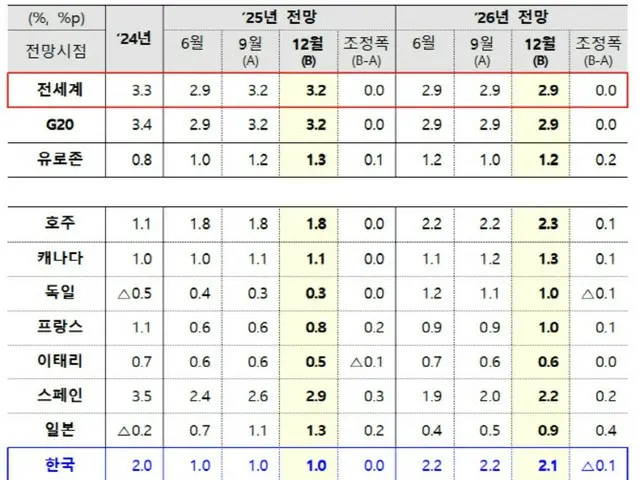
South Korea's growth forecast for this year was maintained at 1.0%, but its growth rate for next year was lowered by 0.1 percentage point from 2.2% to 2.1%.
According to the Ministry of Strategy and Finance of South Korea on the 2nd, the OECD released its "Economic Outlook" with this content. The OECD issues its economic outlook twice a year (May-June and November-December) for member countries and the G20.
The OECD has released its economic outlook for the Korean economy. It has predicted that the Korean economy will grow at 1.0% this year, maintaining its September forecast. This is in line with the Bank of Korea's recent forecast for the Korean economy's growth rate this year.
This is the same level as the long-term rate forecast, and higher than the 0.9% forecast presented by the government, the Korea Development Institute (KDI), and the International Monetary Fund (IMF).
The growth rate of the global economy and the G20 is expected to be 3.2%, higher than that of South Korea, which is also the same as the previous forecast.
Among the major economies, only Germany (0.3%), France (0.8%) and Italy (0.5%) have growth rates lower than South Korea. Meanwhile, Canada (1.1%), Japan (1.3%) and the UK (1.0%) have growth rates lower than South Korea.
The United States (2.0%) and the United States (2.4%) are expected to record higher growth rates than South Korea. The global growth rate next year is expected to be 2.9%, lower than this year. Factors that will push down the growth rate include:
These included further changes in trade policy, a resurgence of inflationary pressures, increased financial market risks due to a sudden adjustment in asset prices, and a contraction in the financial environment due to a deterioration in fiscal soundness.
However, the global economy could grow if trade hurdles are eased, geopolitical uncertainty is reduced, or productivity is boosted through investments in artificial intelligence (AI).
South Korea's economic growth rate next year is forecast to be 2.1%, an improvement from this year. Although this is a 0.1 percentage point downward revision from the previous forecast (2.2%), the government, Bank of Korea, KDI and I
This is a higher level than the forecasts given by the MF (1.8%) and other sources. Growth will be supported by expansionary fiscal policies such as consumption coupons, accommodative monetary policies, a recovery in private consumption due to rising real wages, and improved exports.
Compared to major countries, South Korea's growth rate next year is expected to be lower than the world and G20 growth rates (2.9%), but it is expected to be higher than the US (1.7%), the UK (1.2%), Japan (0.9%), and the US (1.7%).
The OECD believes that it is necessary to strengthen cooperation in the global trading system and increase the predictability of trade policies.
Regarding monetary policy, he emphasized that central banks should remain vigilant and respond promptly to risks to price stability. Furthermore, he stressed that in response to rising public debt,
He also mentioned the need for fiscal discipline to ensure fiscal space to prepare for future shocks.
2025/12/02 21:30 KST
Copyrights(C) Edaily wowkorea.jp 78